If you know me, you probably already know that I’m a big enthusiast of teaching chords at the piano and, above all, of finding creative ways to teach them.
For me, harmony should never be something that students simply learn about. It should be something they play, hear, experiment with and understand.
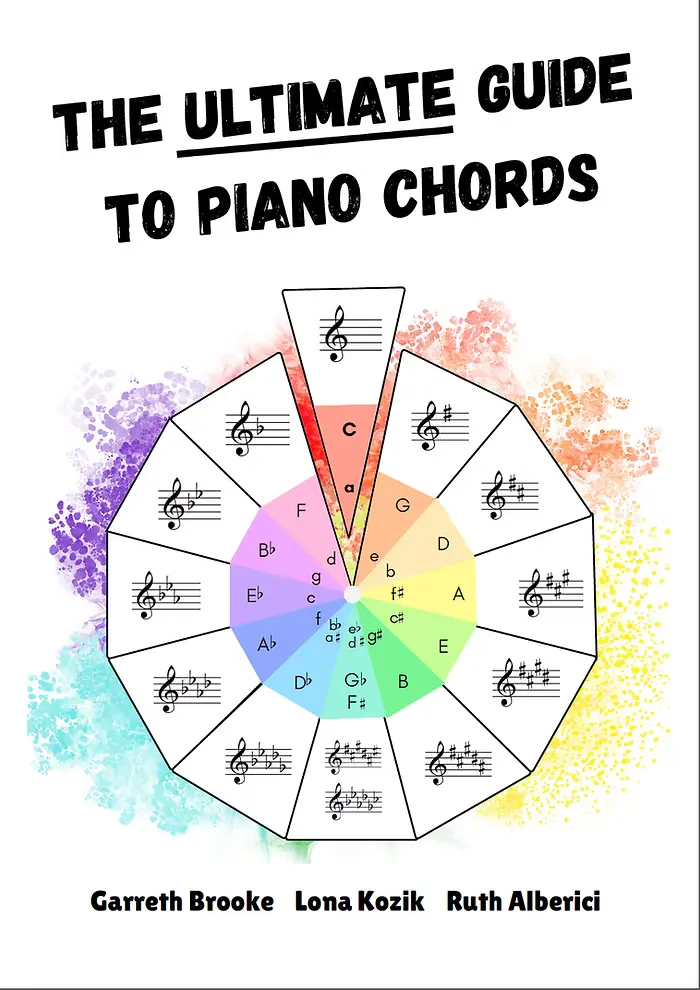
That’s one of the reasons I was so excited to discover The Ultimate Guide to Piano Chords, a new resource created by Garreth Brooke, Ruth Alberici and Lona Kozik. It is a book that fits beautifully with the way I like to approach harmony in my own teaching.
When theory becomes music
One of the biggest challenges when teaching music theory is making sure that students don’t experience it as something disconnected from actually making music.
We’ve all seen it: exercises on paper, terminology to memorise, symbols to identify… and very little connection with what is happening under the fingers and, most importantly, in the ears.
The Ultimate Guide to Piano Chords takes a different approach.
Rather than treating chords as isolated pieces of information, the book encourages students to experience harmony at the piano. And I think that’s a really important distinction. A student who knows that a particular chord is called a dominant seventh has learned a fact. A student who can hear what that chord does, recognise it in a progression, create with it, play it in different keys and understand where it wants to go has developed something much more valuable: harmonic understanding.
A very visual approach
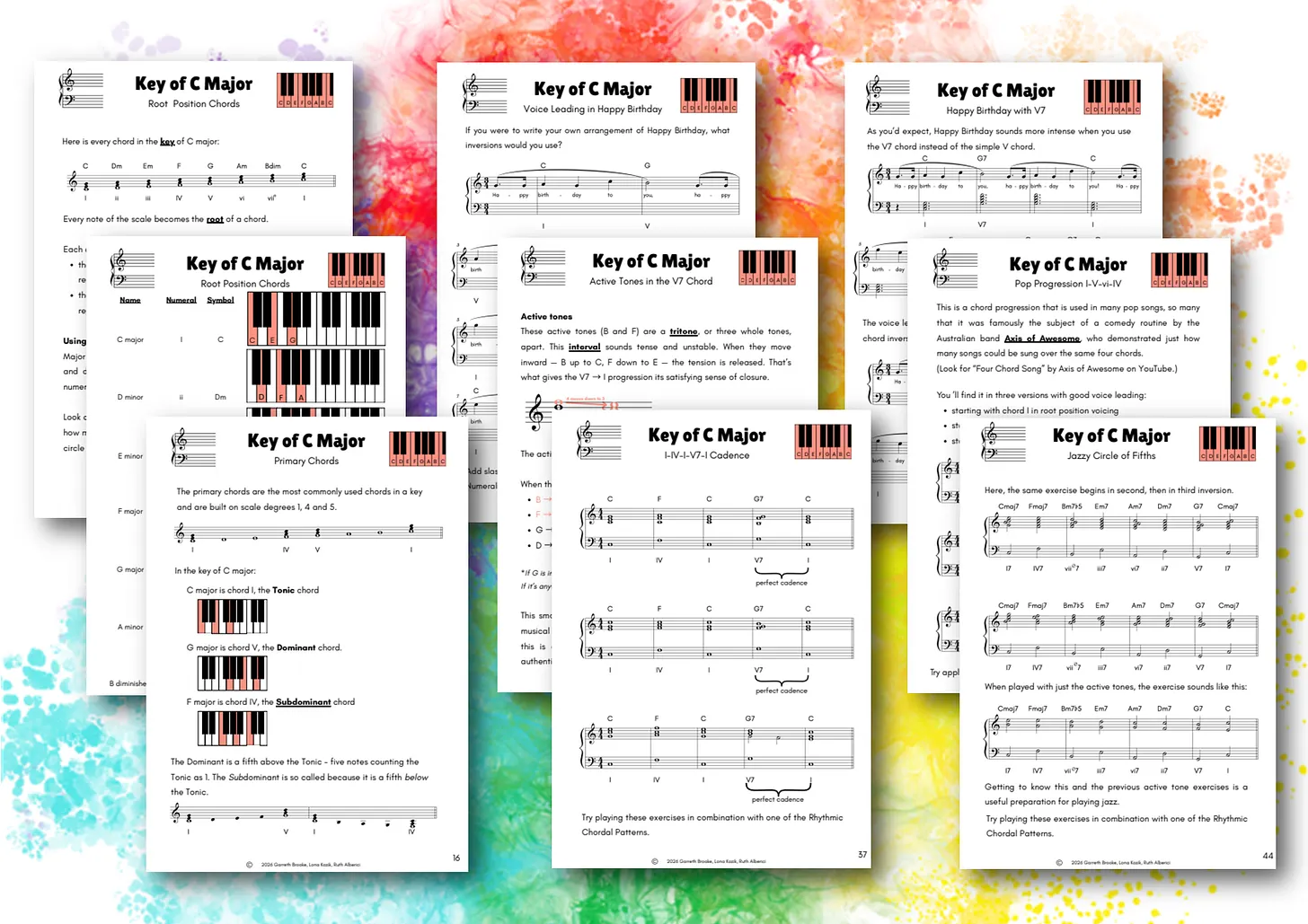
Another thing that immediately caught my attention is the design of the book.
It is extremely visual, clear and approachable. A beautifully organised page can make the difference between something feeling intimidating and something feeling inviting.
The information is broken down into manageable sections, with a visual language that makes the material much easier to navigate. It feels like a resource designed with real piano students in mind, rather than a traditional theory book simply transferred onto the piano.
That clarity is particularly useful when working one-to-one with students because the teacher can quickly find an activity or concept and turn it into a practical lesson at the keyboard.
From basic chords to real musical patterns
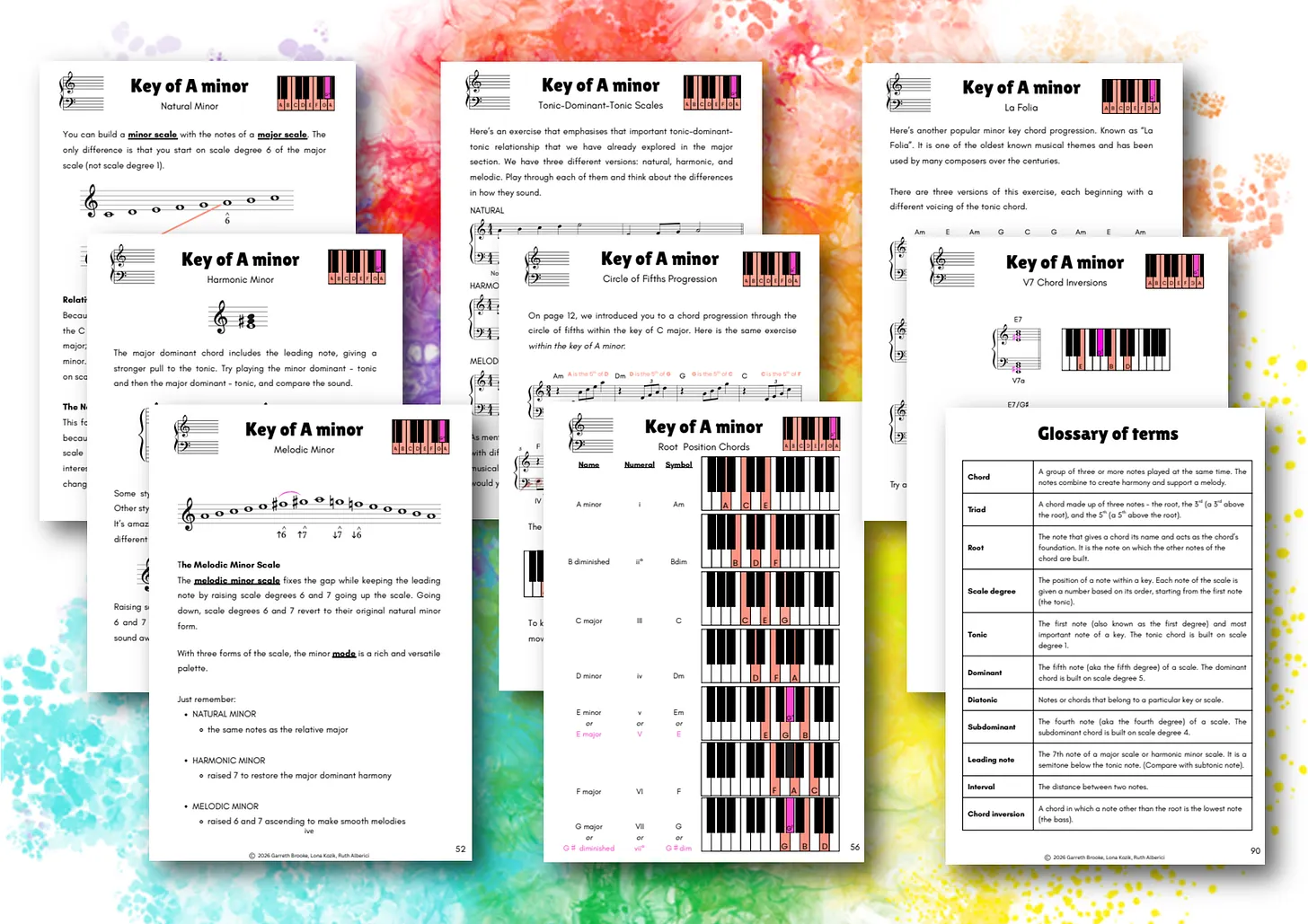
The material progresses from fundamental concepts towards increasingly sophisticated applications of harmony.
Students work with things such as:
- diatonic chords in major and minor keys
- tonic and dominant harmony
- root-position chords and inversions
- cadences
- circle-of-fifths progressions in classical and jazz styles
- minor scales and their relationship to the relative major
- the 12-bar blues
- harmonising Happy Birthday
- chord progressions inspired by Pachelbel’s Canon, La Folia, the “Axis of Awesome” progression and Autumn Leaves
- and much more, including explorations beyond straightforward major and minor tonality
What I particularly like is that these concepts are not presented simply as things to memorise.
They are connected to musical patterns.
And patterns are incredibly powerful when learning harmony.
Once students begin to recognise how chords behave and how progressions are constructed, they can start to see connections between pieces that might initially seem completely unrelated.
That’s when music theory starts becoming something genuinely useful.
Why this book is particularly relevant to me
As I mentioned at the beginning, teaching chords creatively is something I’m particularly passionate about.
My own Piano Patterns in Harmony course grew out of exactly this fascination with patterns, chords and harmonic thinking. I also explore these ideas regularly on my YouTube channel Piano Improv Keys, where I share ideas about harmony, improvisation and playing with chords.
So, naturally, The Ultimate Guide to Piano Chords immediately caught my attention.
I can see lots of possibilities for using it in lessons, not only for students who need to strengthen their theory, but also for those who are beginning to discover improvisation and want to understand what they are actually doing when they play with chords.
If you want to go further into this world, I’d also recommend the Create First! improvisation books by Forrest Kinney. Garreth and I are both big fans of Forrest’s approach, and his books are a wonderful resource for encouraging students to create music from the very beginning rather than waiting until they have mastered a long list of theoretical concepts.
For me, all of these approaches share an important idea: understanding harmony should help students make more music, not simply answer more theory questions.
There is also a personal connection here that makes this project particularly special for me.
I first met Garreth Brooke and Ruth Alberici at the ceremony for The Art of Piano Education Awards 2025. The three of us had all been nominated for awards, and we had a great time together during the evening.
We got on really well, and I remember having some really enjoyable conversations about piano teaching, creativity and education.

(In London with Ruth Alberici, Garreth and Anna Brooke)
So when I later came across the work they were doing on The Ultimate Guide to Piano Chords, it was particularly nice to see where that shared passion for piano education had taken them.
It is always inspiring to see teachers creating resources based on what they have discovered through their own experience with students.
A resource you can keep coming back to
The first edition includes a Guidebook and Workbook covering C major and A minor, with around 150 pages of material.
And this is only the beginning.
The plan is to create workbooks for the other eleven key signatures as well. I think that’s a particularly interesting aspect of the project because students can revisit the same kinds of musical ideas in different keys.
That’s where patterns really begin to sink in.
Instead of learning a progression as a one-off exercise in C major, students can eventually experience the same harmonic relationships across the keyboard. The theory becomes transferable, and the keyboard starts to make much more sense as a musical map.
The resource is also offered with a studio licence, allowing teachers to reproduce the material for their students under the terms of that licence. For teachers who want to incorporate it regularly into their lessons, that’s a very practical feature.
My thoughts
There are many ways of teaching harmony, and no single book is going to replace a good teacher, listening, playing, improvising and discovering music for yourself.
But I think resources like The Ultimate Guide to Piano Chords can make a real difference because they bring several of those things together.
Play first. Hear what is happening. Understand the pattern. Then put a name to it and use it to create, improvise and make your own music!
That approach is very close to the way I think about teaching harmony myself.
And perhaps the most important thing is that students can actually enjoy the process.
Because harmony isn’t just a collection of chord symbols and Roman numerals. It’s one of the things that gives music its direction, colour, tension and emotion.
The more students understand it, the more freedom they have to play with it.
And that’s exactly where the fun begins.
The Ultimate Guide to Piano Chords is a fascinating addition to the piano teacher’s toolkit, especially if, like me, you believe that music theory works best when theory and playing are inseparable.
You can buy The Ultimate Guide to Piano Chords at the following links:



0 Comments